Exponentielle, logarithme népérien
Il existe une fonction unique {x\mapsto y(x)}, dérivable sur {\mathbb{R}}, et telle que : {\begin{cases}\forall\, x\in\mathbb{R},\;y'(x)=y(x)\\[4pt] y(0)=1\end{cases}}
On l’appelle la fonction exponentielle, et on la note {x\mapsto \exp(x)}.
La fonction {x\mapsto\exp(x)} est une bijection strictement croissante de {\mathbb{R}} sur {\mathbb{R}^{+*}}.
Sa bijection réciproque, de {\mathbb{R}^{+*}} sur {\mathbb{R}}, appelée fonction logarithme népérien, est notée {x\mapsto \ln x}.
Propriétés
-
Par définition, on a l’équivalence : {\begin{cases}y=\exp(x)\\[4pt] x\in\mathbb{R}\end{cases}\;\Leftrightarrow\;\begin{cases}x=\ln(y)\\[4pt] y>0\end{cases}}
-
La fonction {x\mapsto\exp(x)} est indéfiniment dérivable sur {\mathbb{R}} et : {\forall\, n\in\mathbb{N},\;\exp^{(n)}=\exp}.
La fonction {x\mapsto\ln(x)} est définie sur {\mathbb{R}^{+*}} par : {\forall\, x>0,\;\ln'(x)=\dfrac1x} et {\ln(1)=0}.
La fonction {x\mapsto\ln(x)} est strictement croissante et indéfiniment dérivable sur {\mathbb{R}^{+*}}.
-
On note {\mathrm{e}} l’unique réel strictement positif tel que {\ln(e)=1}. On a : {\mathrm{e}\approx2.718281828}.
-
Le logarithme népérien est l’unique primitive sur {\mathbb{R}^{+*}}, s’annulant en {x=1}, de la fonction {x\mapsto\dfrac1x}.
En d’autres termes : {\forall x>0,\; \ln(x)=\displaystyle\int_1^x\dfrac{\,\mathrm{d}t}t}.
-
La fonction {x\mapsto\exp(x)} est convexe sur {\mathbb{R}} (sa dérivée seconde est {\exp(x)>0}).
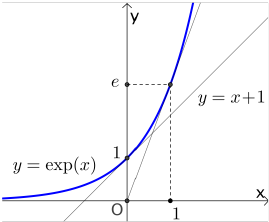
Pour tout {x} de {\mathbb{R}}, on a l’inégalité {\exp(x)\ge1+x} (égalité{\;\Leftrightarrow\; x=0}).
La fonction {x\mapsto\ln(x)} est concave (sa dérivée seconde est {-\dfrac1{x^2}\lt 0}).
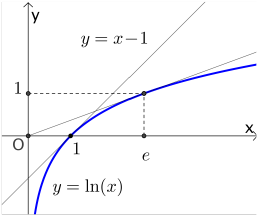
Pour tout {x>0}, on a l’inégalité {\ln(x)\le x-1} (égalité{\;\Leftrightarrow\; x=1}).
Courbes représentatives des fonctions {x\mapsto\mathrm{e}^{x}} et {x\mapsto\ln(x)} :
Propriétés fonctionnelles :
Pour tous {x,y} de {\mathbb{R}} : {\exp(x+y)=\exp(x)\;\exp(y),}
{\exp(-x)=\dfrac1{\exp(x)},}
{\exp(x-y)=\dfrac{\exp(x)}{\exp(y)}}.
Pour tous {x,y} de {\mathbb{R}^{+*}} : {\ln(xy)=\ln(x)+\ln(y),}
{\ln\Bigl(\dfrac1x\Bigr)=-\ln(x),}
{\ln\Bigl(\dfrac{x}{y}\Bigr)=\ln(x)-\ln(y)}.
Notation {x\mapsto\mathrm{e}^x}
Pour tout {n} de {\mathbb{N}}, on a {\exp(n)=\exp(1)^n=\mathrm{e}^n}.
Cette propriété se généralise aux exposants rationnels.
On décide d’étendre encore cette définition en posant : {\forall\, x\in\mathbb{R},\;\mathrm{e}^x=\exp(x)}.
On définit ainsi les puissances de {\mathrm{e}} avec exposant réel quelconque.
Toutes les propriétés de la fonction exponentielle peuvent alors se réécrire en utilisant cette notation.
Limites usuelles :
Pour l’exponentielle : {\left\{\begin{aligned}&\displaystyle\lim_{x\to-\infty}\exp(x)=0^+,\\[4pt]&\quad\displaystyle\lim_{x\to+\infty}\exp(x)=+\infty,\\[4pt]&\quad \displaystyle\lim_{x\to+\infty}\dfrac{\exp(x)}x=+\infty\\[4pt]&\displaystyle\lim_{x\to-\infty}x\exp(x)=0,\\[4pt]&\quad\displaystyle\lim_{x\to0}\dfrac{\exp(x)-1}x=1\end{aligned}\right.}
Pour le logarithme népérien : {\left\{\begin{aligned}&\displaystyle\lim_{x\to0^+}\ln(x)=-\infty,\\[4pt]&\quad\displaystyle\lim_{+\infty}\ln(x)=+\infty,\\[4pt]&\quad\displaystyle\lim_{x\to0^+}x\ln(x)=0^-\\[4pt]&\displaystyle\lim_{x\to+\infty}\dfrac{\ln(x)}x=0^+,\\[4pt]&\quad\displaystyle\lim_{x\to0}\dfrac{\ln(1+x)}x=1,\\[4pt]&\quad \displaystyle\lim_{x\to1}\dfrac{\ln(x)}{x-1}=1\end{aligned}\right.}