Soit {\mathcal{A}} et {\mathcal{B}} deux propositions vraies ou fausses.
On peut former les propositions suivantes, dont la valeur de vérité est fonction de celles de {\mathcal{A}} et {\mathcal{B}.}
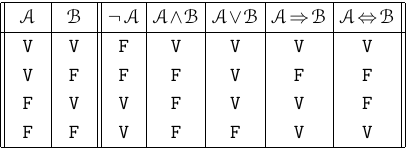
- la négation {\neg A} de {\mathcal{A}(}« non {\mathcal{A}} ») {\mathcal{A}\Rightarrow \mathcal{B}\equiv \neg \mathcal{A}\vee \mathcal{B}\equiv \neg (\mathcal{A}\wedge \neg \mathcal{B})}
- la conjonction {\mathcal{A}\wedge \mathcal{B}(}« {\mathcal{A}} et {\mathcal{B}} ») {\mathcal{A}\Leftrightarrow \mathcal{B}\equiv (\mathcal{A}\Rightarrow \mathcal{B})\wedge (\mathcal{B}\Rightarrow \mathcal{A})}
- la disjonction {\mathcal{A}\vee \mathcal{B}(}« {\mathcal{A}} ou {\mathcal{B}} ») {\equiv (\mathcal{A}\wedge \mathcal{B})\vee (\neg \mathcal{A}\wedge \neg \mathcal{B})}
- l’implication {\mathcal{A}\Rightarrow \mathcal{B}} {\equiv (\mathcal{A}\vee \neg \mathcal{B})\wedge (\neg \mathcal{A}\vee \mathcal{B})}
- l’équivalence {\mathcal{A}\Leftrightarrow \mathcal{B}}
Pour voir la suite de ce contenu, vous devez :
- avoir une souscription active sur mathprepa
- et être connecté au site
- revenir à la page d'accueil
- ou tester la page d'extraits libres